Technical Article
Ceramic Sintering: How Loose Powder Becomes a Dense Body
Ceramic sintering turns a loose powder compact into a dense body: particle contact, atomic migration, pore contraction, and grain growth occur simultaneously. Only by understanding what driving forces each of these processes consumes and the paths along which they proceed can we explain how a loose billet acquires strength, density, and dimensional stability.
Although the compacted powder appears to have taken shape, its interior still consists of numerous particle contact points and interconnected pores. Upon heating, the system reduces the number of high-energy surfaces through material migration; necks form at the particle contact points, the pores gradually shrink, and the green body undergoes macroscopic shrinkage. The direct result of sintering is the transformation of the particle aggregate into a dense solid with a continuous load-bearing framework.
Contents
- Why do powders spontaneously lose surface area?
- Why neck growth does not always produce shrinkage
- How the pore structure evolves through three stages
- How grain boundary structure changes sintering kinetics
- Suppressing coarsening without losing the driving force
- How a liquid phase accelerates rearrangement and pore removal
- Why inhomogeneous green bodies warp and crack
- How fast heating and external fields reshape the time scale
- How to establish a stable sintering window
Why Do Powders Spontaneously Lose Surface Area?
When a material of the same mass is divided into many fine particles, it results in a large total surface area. As long as the surface energy per unit area is positive, the total surface energy increases as the surface area increases. The powder system is therefore in a higher-energy state; reducing the solid–gas surface area and adjusting the solid–solid interface area can lower the free energy.
This energy difference does not automatically determine which path an atom will take. It merely provides a direction; the migration rate also depends on temperature, the diffusion coefficient, interfacial reactions, liquid-phase viscosity, and applied stress. Surface energy provides the driving force, while kinetics determine how far the atom can travel within the experimental timeframe.
The neck region at the particle contact point shows a pronounced change in curvature. The chemical potential of atoms near a curved surface follows the Gibbs–Thomson relation below, where γ is the interfacial energy, Ω is the atomic volume, and κ is the mean curvature (κ = 1/r₁ + 1/r₂):
μ = μ0 + γΩκ
The surfaces of protruding particles, concave necks, and pores have different curvatures and, consequently, different chemical potentials. Atoms migrate from regions of higher chemical potential to regions of lower chemical potential, causing material to gradually accumulate near the contact points. The smaller the radius of curvature, the stronger the local driving force tends to be; therefore, fine powders exhibit higher sintering activity.
As the neck grows, the effective contact area increases, local stress concentrations diminish, and the particle aggregate begins to exhibit significant mechanical strength. The formation of the neck serves as a geometric indicator that sintering has begun; whether macroscopic densification occurs depends on the location of the material source.
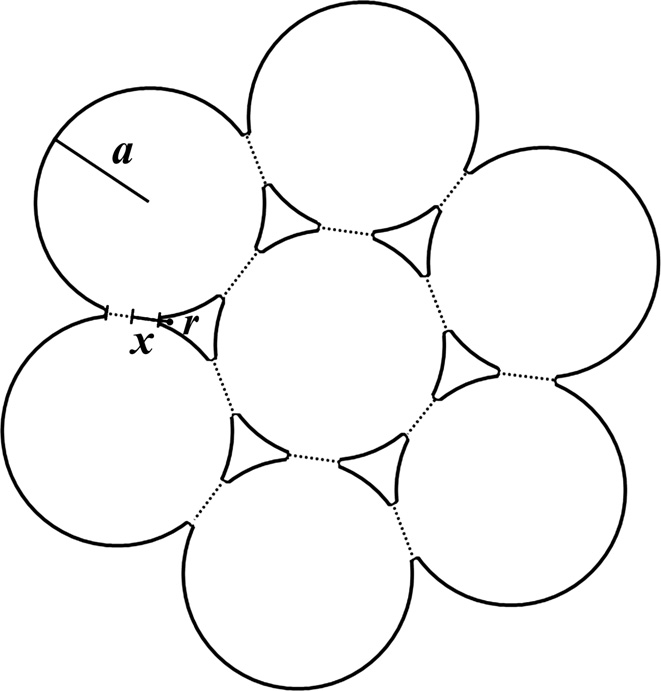
Figure 1. The particle radius a, neck radius x, and neck curvature radius r define the local geometry; after the material migrates to the neck, interparticle connections are formed.
Why Neck Growth Does Not Always Produce Shrinkage
If an atom starts from the free surface of a particle and reaches the neck via surface diffusion or evaporation-condensation, the particle will become rounder and the neck will thicken, but the distance between the centers of adjacent particles will change only slightly. This process enhances contact but contributes little to volume contraction. Neck enlargement and densification are two quantities that must be measured separately.
If material moves out from one side of the grain boundary in the particle contact zone and then diffuses along the grain boundary or through the crystal lattice to reach the neck and the pore surface, the contact surfaces will move closer together, the interparticle center-to-center distance will shorten, and the macroscopic size will consequently decrease. Only mass transfer pathways that shorten the center-to-center distance directly lead to densification.
The diffusion coefficient typically follows the Arrhenius equation:
D = D0 · exp(−Q/RT)
An increase in temperature exponentially enhances the rate of diffusion. Particle size, defect concentration, grain boundary conditions, and the atmosphere, in turn, alter D0 or the apparent activation energy Q. A given temperature does not correspond to a unique sintering rate; depending on the powder source and thermal history, the densification curve may shift significantly.
Atomic migration also involves a series of steps, including detachment from the source, passage through the diffusion channel, and attachment at the sink. If any of these interfacial reactions slows down, the overall rate will be limited. Explaining all crystal sintering using only a single bulk diffusion coefficient can easily lead to overlooking the attachment resistance at ordered interfaces.
How the Pore Structure Evolves Through Three Stages
During the early stages of sintering, both the solid-phase network and the pore network remain interconnected; the primary change is a rapid thickening of the connections between adjacent particles, while the increase in density is not yet significant. The x/a ratio is commonly used to describe the neck size; when x/a is small, the initial model can relate particle size, diffusion pathways, and holding time.
During the intermediate stage, pores often form through-channels along grain edges, and most of the macroscopic shrinkage occurs during this stage. Diffusion across grain boundaries and lattice diffusion continuously transport material toward the pore surfaces, causing the pore diameters to decrease and connectivity to gradually weaken. The intermediate sintering window determines whether density can be rapidly increased without causing premature grain coarsening.
After the pore closes, the remaining voids are dispersed at grain boundary intersections or within the grains. If the voids can move along with the grain boundaries and remain in contact with them, there is still a chance for them to continue shrinking; however, if the grain boundaries migrate too quickly, the voids will become separated from the grain boundaries and remain inside the grains, making their removal significantly more difficult.
Densification and grain growth share the same atomic migration resources but lead to different structural outcomes. The two trajectories shown in the figure indicate that a material can increase its relative density by following a densification path, or it can first increase grain size by following a coarsening path. A high-density, fine-grained microstructure requires that the densification rate remain higher than the ineffective coarsening rate over the long term.
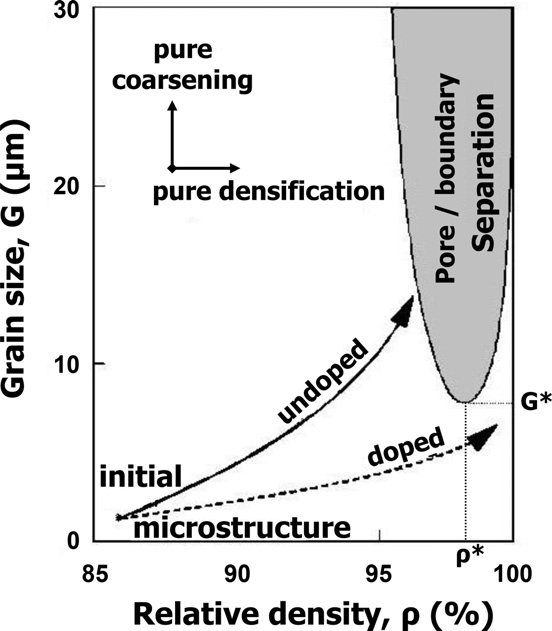
Figure 2. The evolution curves of relative density versus grain size clearly distinguish the process regions corresponding to densification, coarsening, and pore-grain boundary separation.
Additives, heating rates, and holding regimens alter the shape of these curves. Once pores detach from grain boundaries and become trapped within the grains, further prolonging the holding time typically only leads to grain coarsening, with minimal gains in density.
How Grain-Boundary Structure Changes Sintering Kinetics
Atomic-scale rough interfaces have more sites available for atomic adsorption, so interfacial reactions typically proceed more rapidly; ordered interfaces with well-defined small planes require the formation of steps or two-dimensional nuclei, and migration may require a driving force exceeding the critical value. The interface structure thus plays a role in controlling densification and grain growth, and the diffusion rate is no longer the sole rate-limiting factor.
Rough grain boundaries, small-plane grain boundaries, and pore shapes can also alter the direction of mass transfer. Figure 3 uses red and blue arrows to distinguish atomic flows associated with grain growth and densification, respectively. Even materials with the same chemical composition may exhibit different sintering trajectories depending on the degree of interface order.
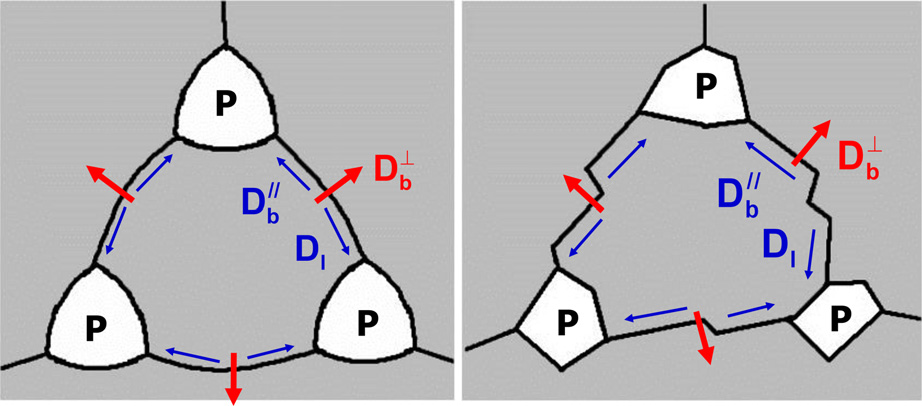
Figure 3. Rough interfaces and small-area interfaces correspond to different grain boundaries, lattice diffusion directions, and interfacial reaction conditions, thereby altering the relative rates of densification and grain growth.
This also explains why even a small amount of doping can have a significant effect. Doping elements can segregate at grain boundaries, altering interfacial energy, structure, diffusion rates, space charge, or the tendency to form liquid phases. The effects of doping must be evaluated in conjunction with the atmosphere, temperature, and the state of the grain boundaries.
Suppressing Coarsening Without Losing the Driving Force
Surface diffusion, vapor transport, and certain forms of migration along interfaces can cause particles to coarsen without resulting in corresponding shrinkage. Process design should aim to suppress these non-densifying pathways and promote material flow toward the pore surface along grain boundaries or through the crystal lattice. Rapid heating, two-step sintering, grain boundary pinning, and atmosphere control can all be used to alter the relative magnitudes of these two types of rates.
The smaller the particle size, the higher the driving force; however, agglomeration, impurity adsorption, and surface reactions also become more pronounced. If nanopowders form hard agglomerates, the contraction inside and outside the agglomerates is out of sync, which can actually lead to the retention of large pores. While fine powders offer high reactivity, this does not automatically guarantee uniform densification.
How a Liquid Phase Accelerates Rearrangement and Pore Removal
Once the temperature reaches the liquid-phase formation range for a particular component, the liquid spreads along the particle interfaces. Capillary forces drive particle rearrangement, and the liquid film provides a rapid pathway for dissolution, diffusion, and precipitation. The efficiency of liquid-phase sintering is governed by the degree of wetting, the volume fraction of the liquid phase, viscosity, and the solubility of the solid phase.
Initial rearrangement improves contact, but its contribution to density is often lower than estimated by simple geometric models. Subsequently, the solid phase dissolves in the compressed contact zone; the solute passes through the liquid film and precipitates at locations of lower chemical potential, gradually flattening the contact surface and reducing the interparticle center-to-center distance. Dissolution–transport–precipitation converts capillary pressure into sustained densification.
The contact flattening model predicts a gradual reduction in pore size across all size ranges; the pore-filling model, in contrast, describes the sequential filling of pores by the liquid according to pore size and local pressure conditions, with small pores typically disappearing earlier and large pores responding later. These two mechanisms result in different evolutions of the pore size distribution.
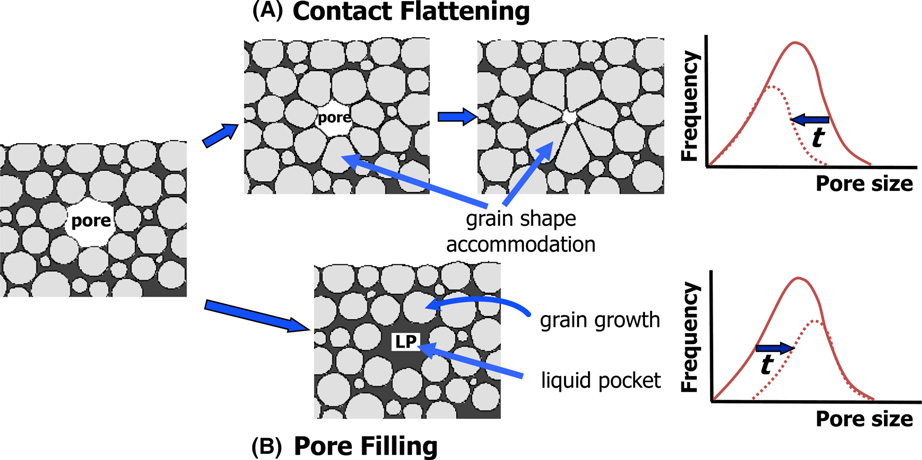
Figure 4. Contact flattening and pore filling result in different evolutions of pore size distribution; the former drives an overall decrease in pore size, while the latter fills the pores in order of pore size.
Recording pore size distributions using mercury intrusion, image statistics, or 3D characterization allows for the distinction between two types of processes. An identical average pore size does not imply that the pores disappear in the same way; the proportion of large-pore tails and isolated pores often provides a better indication of the final density.
When the liquid phase is insufficient, it is difficult to establish a continuous liquid film and achieve sufficient wetting; conversely, when the liquid phase is excessive or remains after cooling, it may reduce high-temperature performance, introduce brittle phases, or alter dimensions. Both the amount of the liquid phase and the phase composition after cooling must be controlled.
Why Inhomogeneous Green Bodies Warp and Crack
Factors such as compaction friction, particle flow, packing height, and die geometry cause spatial variations in green compact density. Low-density regions contain more voids to be eliminated, and the local free shrinkage is typically greater; high-density regions exhibit less shrinkage. Differences in green compact density are amplified during sintering, resulting in variations in shape and properties.
When a thin film is bonded to a rigid substrate, when multilayer materials have different sintering rates, or when the shrinkage rates of different phases in a composite material are inconsistent, free shrinkage is constrained, and internal stresses vary with density. Layers that shrink more rapidly can pull on slower-shrinking layers, causing warpage, delamination, or cracking.
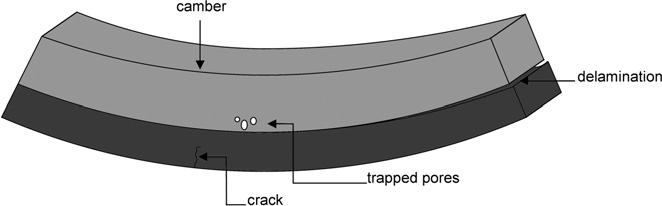
Figure 5. Mismatched sintering rates in a two-layer green body can cause warping, interlayer cracking, cracks, and residual porosity.
The alignment of shrinkage curves is more important than a single peak temperature. Even if the two layers of material reach approximately the same density at the same final temperature, stresses will still accumulate as long as their shrinkage rates differ during the process. Laminated structures require relatively complete expansion–shrinkage–viscoelastic response curves.
How Fast Heating and External Fields Reshape the Time Scale
Spark plasma sintering (SPS) typically employs conductive dies, pulsed or direct current, and axial pressure to achieve rapid heating and pressure-assisted densification. Pressure increases particle contact and promotes viscoplastic flow, while Joule heating shortens the high-temperature residence time. Rapid heating facilitates the attainment of high density before significant grain growth occurs.
The electrical resistance, thermal conductivity, and geometric dimensions of the die, punch, and specimen create a complex temperature field. Uneven temperature distribution further alters local resistance and shrinkage rates, resulting in mutual coupling. Single-point temperatures recorded by the equipment do not represent all locations within the specimen.
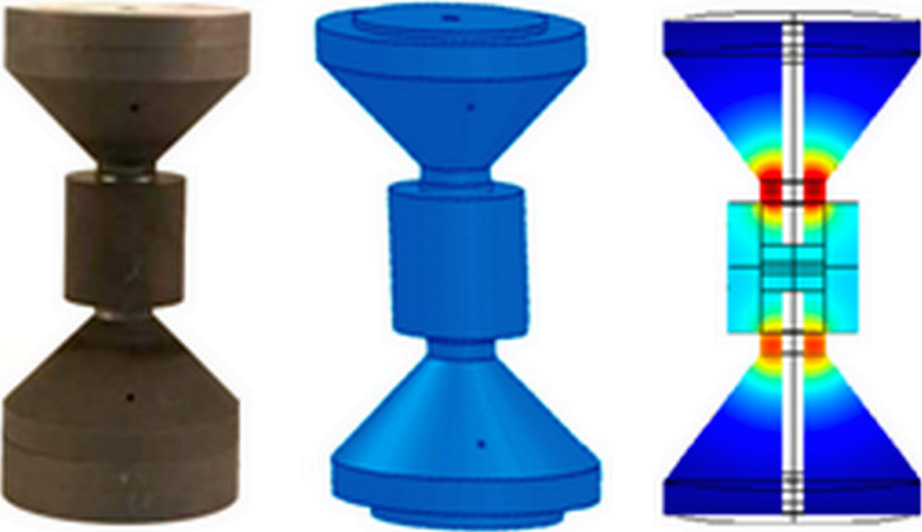
Figure 6. The temperature field in an SPS die-punch assembly exhibits spatial variations; local temperatures can alter local shrinkage rates and final density.
Whether an electric field produces non-thermal effects independent of rapid heating depends on the material’s electrical properties, field strength, and comparable experiments. When evaluating field effects, it is essential to match the actual sample temperature, heating rate, pressure, and dimensions; otherwise, differences in thermal history may confound the conclusions.
Microwave energy couples with the material’s dielectric response, enabling rapid volumetric heating and shortening the holding time. Multiphase materials absorb microwaves differently, and localized heating further alters absorption and electrical conductivity, potentially leading to positive feedback in the thermal field. Hot spots can accelerate localized densification but may also create density gradients.
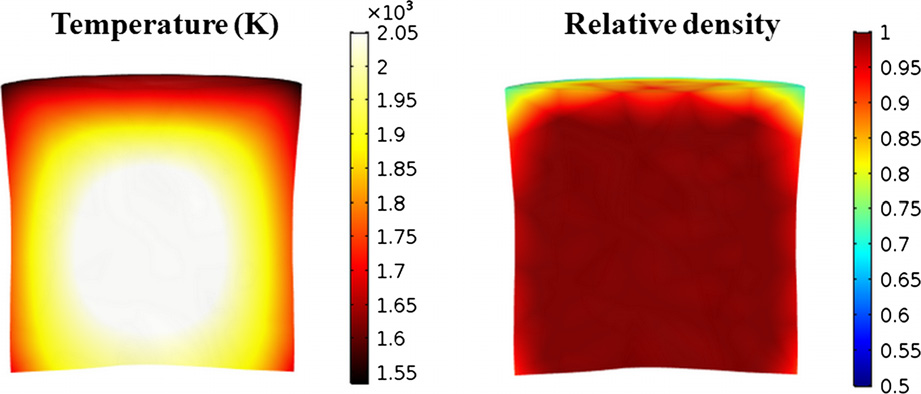
Figure 7. After coupling the electromagnetic field, heat conduction, and densification during microwave sintering, localized hot spots can drive simultaneous instabilities in temperature and relative density.
Temperature measurements, insulation materials, sample dimensions, and field distributions must be determined within the same experimental design. When the heating rate is high, measurement errors and spatial gradients can significantly amplify the uncertainty in identifying the underlying mechanisms.
How to Establish a Stable Sintering Window
A single-endpoint density measurement cannot fully characterize the process. A more effective combination of experiments includes: using a thermal expansion analyzer to record continuous contraction; performing stepwise quenching to observe pore connectivity; analyzing microscopic images to determine grain and pore size distributions; conducting geometric measurements to record warpage; and performing local composition and grain boundary analyses to track additives.
The process window must at least constrain the densification rate and the grain growth rate, and verify that spatial shrinkage is uniform. Temperature and time provide the heat budget; atmosphere controls defect chemistry and volatilization; pressure alters contact and viscoplastic response; and the particle size distribution determines the initial pore network.
- Powder level: particle size and distribution, agglomerate strength, specific surface area, impurities, and surface condition.
- Forming level: green compact density, density gradient, pore size tail, interlayer bonding, and residual stress.
- Thermal profile level: heating rate, dwell time in critical temperature zones, final temperature, cooling process, and partial pressure of the atmosphere.
- Microstructural level: Relative density, open/closed pores, grain size distribution, anomalous grains, and the relationship between pores and grain boundaries.
By correlating continuous shrinkage curves with segmented microstructures, it is possible to determine whether shrinkage in a given segment results from neck formation, pore closure, liquid-phase filling, or pressure-assisted flow, thereby avoiding the need to infer the entire process solely from the final microstructure.
Multiscale models are used to link local mechanisms to component-level results.
Particle-scale models describe contact, porosity, and grain evolution; continuum models handle density fields, stress, temperature, and shape at the component scale. By exchanging parameters between the two, it is possible to predict non-uniform sintering in complex geometries, with inclusions, in constrained layers, and under external fields.
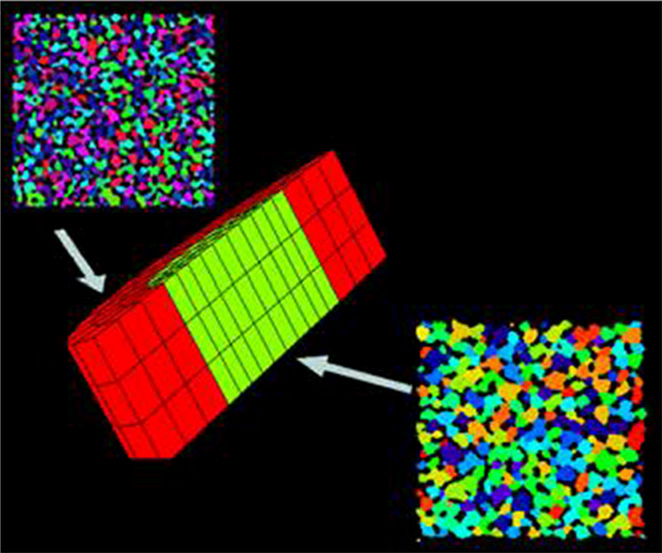
Figure 8. A multiscale model linking the shape and density field at the component scale with the evolution of the local pore-grain structure, used to predict non-uniform sintering.
The reliability of the model depends on the actual material parameters and in-situ data. Viscosity, sintering stress, grain boundary mobility, thermal conductivity, and electrical conductivity all vary with temperature and density. Using constant parameters across the entire sintering range can easily lead to results that appear plausible but are mechanistically incorrect.
Conclusion
The transformation of powder into a dense solid relies on material migration driven by a decrease in surface energy; whether shrinkage occurs depends on the source of material, migration pathways, pore connectivity, and boundary conditions. The goal of a stable process is to ensure that densification consistently outpaces coarsening, while also controlling spatial variations in temperature, density, and stress.
Reference
[1] Bordia, R. K., Kang, S.-J. L., & Olevsky, E. A. (2017). Current understanding and future research directions at the onset of the next century of sintering science and technology. Journal of the American Ceramic Society, 100(6), 2314–2352. https://doi.org/10.1111/jace.14919
[2] Kang, S.-J. L., Lee, M.-G., & An, S.-M. (2009). Microstructural evolution during sintering with control of the interface structure. Journal of the American Ceramic Society, 92(7), 1464–1471. https://doi.org/10.1111/j.1551-2916.2009.03106.x
[3] German, R. M., Suri, P., & Park, S. J. (2009). Review: Liquid phase sintering. Journal of Materials Science, 44, 1–39. https://doi.org/10.1007/s10853-008-3008-0
[4] Olevsky, E., Tadesse Molla, T., Frandsen, H. L., Bjørk, R., Esposito, V., Ni, D. W., Ilyina, A., & Pryds, N. (2013). Sintering of multilayered porous structures: Part I—Constitutive models. Journal of the American Ceramic Society, 96(8), 2657–2665. https://doi.org/10.1111/jace.12375
[5] Hu, Z.-Y., Zhang, Z.-H., Cheng, X.-W., Wang, F.-C., Zhang, Y.-F., & Li, S.-L. (2020). A review of multi-physical fields induced phenomena and effects in spark plasma sintering: Fundamentals and applications. Materials & Design, 191, 108662. https://doi.org/10.1016/j.matdes.2020.108662
[6] Rybakov, K. I., Olevsky, E. A., & Krikun, E. V. (2013). Microwave sintering: Fundamentals and modeling. Journal of the American Ceramic Society, 96(4), 1003–1020. https://doi.org/10.1111/jace.12278
Need support with ceramic material selection or component requirements?
Contact Our Team