17-December-2025
The demand for enhanced performance in modern scientific and industrial technologies, ranging from high-current power electronics to sophisticated vacuum electron devices (VEDs), necessitates robust and reliable joining between ceramic insulators and metallic conductors. Alumina ceramics, prized for their high dielectric strength, high mechanical rigidity, and excellent thermal stability, present significant challenges when joined directly to metals. Structurally, ceramics possess ionic or covalent bonds, rendering their surfaces chemically inert to common molten braze alloys, while metals are characterized by metallic bonds. This fundamental difference in chemical nature prevents direct wetting and metallurgical reaction.
Beyond chemical incompatibility, the substantial difference in the Coefficient of Thermal Expansion (CTE) between Alumina and common structural alloys (such as Kovar) dictates the need for a carefully engineered interface. Since Molybdenum-Manganese metallization and subsequent ceramic brazing occur at high temperatures (>800°C), the assembly is subject to severe residual stresses upon cooling to ambient temperature. The function of the intermediate Mo-Mn layer is therefore two-fold: to create a stable chemical anchor to the inert ceramic and to provide a porous, ductile-like metallic matrix that can effectively transition the stress gradient between the two vastly different material carriers, ensuring joint integrity and long-term durability.
Historically, electrical feedthroughs relied upon glass-to-metal (GTM) seals. GTM seals function by exploiting controlled thermal expansion matching, where specialized glasses are matched to alloys like Kovar. While effective for electrical insulation and moderate pressure environments, glass-based systems suffer from inherent thermal limitations. Glass-to-metal seals are typically limited to maximum operating temperatures around 450°C.
The rapid evolution of high-frequency components, large-current power modules, and specialized vacuum equipment requires components capable of operating reliably under extreme conditions, including very high voltages and temperatures exceeding 800°C. Alumina (Al2O3), particularly grades like 95% Alumina, offers superior thermal and electrical performance, making it the material of choice for these demanding applications. Ceramic-to-metal (CTM) seals employing Alumina promise a more lasting and leak-free connection, which is vital for ultra-high vacuum (UHV) environments such as those found in space simulation chambers and advanced electrical feedthroughs, where even minimal leakage compromises operational integrity. Although the process of creating CTM seals requires increased labor and complexity compared to GTM seals, the performance advantages—namely high sealing intensity, excellent air-tightness (hermeticity), and superior thermal cycle reliability—justify the investment for high-reliability manufacturing.
To enable the robust joining of Alumina to metal components, the inert ceramic surface must be activated. Molybdenum-Manganese metallization is the predominant, mature technology utilized for high-temperature refractory metallization. This technique chemically modifies the Alumina surface to create an intermediate, highly wettable layer that facilitates subsequent high-temperature ceramic brazing.
The success of the Mo-Mn method is intrinsically linked to the chemical composition of the Alumina substrate. Specifically, the 95% Alumina grade, which contains minor silicate impurities, is optimal because these impurities form a glass phase at grain boundaries. This inherent glass phase is a functional requirement, as it participates directly in the chemical bonding mechanism. Were manufacturers to utilize high-purity Alumina (e.g., 99.9%), the Mo-Mn method would lose its primary reaction pathway, potentially necessitating a shift to complex alternatives like Active Metal Brazing (AMB). Therefore, the deployment of Molybdenum-Manganese metallization is a critical, material-specific technological solution driven by the performance demands of advanced packaging.
The Mo-Mn process is a complex, high-temperature reaction sequence involving solid-state powder metallurgy, glass phase dynamics, and controlled redox chemistry. The strong and hermetic bond achieved between the Alumina ceramic and the refractory metal paste is the result of a synergistic multi-factor mechanism : 1) chemical reaction leading to stable crystalline phases, 2) physical infiltration via glass phase migration, and 3) Molybdenum powder sintering.
The 95% Alumina substrate contains a silicate-based glass phase at its grain boundaries. During the high-temperature firing step (1300°C to 1600°C), this grain boundary phase softens, becoming highly fluid above 1500°C. This phase migration is essential for the bonding process.
The glass phase, reduced in viscosity, infiltrates the porous network formed by the Molybdenum particles. This infiltration creates a strong physical lock between the ceramic and the metallic layer. However, the sintering temperature must be tightly controlled within a narrow window.
If the temperature is too low, the ceramic glass phase remains too viscous, preventing sufficient penetration into the metallic powder layer, leading to inadequate physical anchoring and eventual bond failure. Conversely, if the temperature is excessive (e.g., significantly above 1550°C), the glass viscosity drops too low. This causes aggressive infiltration and leaching, where the glass phase migrates excessively to the metal surface. The resulting thin metallic layer and the accumulation of silicate glass on the surface critically compromise the adhesion of the subsequent Nickel plating layer, thereby drastically reducing the final joint strength after ceramic brazing. The 1550°C mark often represents the optimal high-temperature metallization point where chemical kinetics and Mo sintering are maximized, while detrimental glass leaching is minimized.
The true chemical anchor of the Molybdenum-Manganese metallization layer is the reaction initiated by the Manganese component. During the primary sintering phase, the Manganese powder (typically 7-20% by weight in the paste) acts as the primary chemical activator.
The sintering atmosphere is crucial. While a reducing atmosphere (such as Hydrogen or Hydrogen/Nitrogen forming gas) is required to prevent the catastrophic oxidation of Molybdenum, the process requires the controlled presence of water vapor (humidity or dew point) to selectively oxidize the Manganese. Manganese has a sufficiently high affinity for oxygen that it is oxidized to Manganese oxide (MnO) even in a humid Hydrogen atmosphere. The specific dew point of the furnace atmosphere controls the H2O/H2 partial pressure ratio, ensuring Mn oxidation occurs without oxidizing the Mo.
Once formed, the MnO dissolves into the ceramic's liquid silicate glass phase, lowering its viscosity. The MnO then reacts with the Alumina (Al2O3) to form highly stable crystalline compounds, principally Manganese aluminate spinel (MnO·Al2O3 or MnAl2O4). This thermodynamically stable spinel interlocks with the ceramic lattice, forming the robust chemical bond. The resulting layer structure transitions from the ceramic body through the crystalline spinel layer and into the metallic Molybdenum skeleton.
Molybdenum powder, constituting the majority of the paste (typically 60-86% by weight), provides the conductive and mechanically stable framework. During high-temperature firing, the Molybdenum particles undergo sintering, forming a rigid, interconnected skeleton. This skeleton is highly porous before the infiltration step.
As the Manganese-activated glass phase flows into the layer, it fills the pores within the Mo skeleton. This filling mechanism ensures the final Molybdenum-Manganese metallization layer is dense, conductive, and achieves the critical hermetic seal. The resultant layer is a composite structure, approximately 10 to 30 µm thick, characterized by Molybdenum particles surrounded by a glass matrix.
The interdependency of these processes—Manganese chemistry, glass phase dynamics, and Mo sintering—means that minute variations in temperature or atmosphere composition can drastically alter the final microstructure, directly impacting bond strength and hermeticity.
Table 1: Typical Composition and Function of High-Temperature Mo-Mn Metallization Paste
The successful production of a high-reliability CTM seal using Molybdenum-Manganese metallization depends on stringent control across a multi-stage process, beginning with meticulous cleaning and ending with secondary high-temperature firing.
The integrity of the final bond is highly sensitive to the presence of surface contaminants, including oils, residual machining dust, and metal ions. Therefore, rigorous surface preparation of the Alumina ceramic is mandatory.
The cleaning protocol typically involves a multi-step chemical and physical treatment:
1. Initial Debris Removal: Gentle mechanical cleaning (using a soft brush) is employed to remove large, visible debris and spots on the ceramic surface before introducing sophisticated chemical processes.The metalizing paste is a complex suspension of metal powders, glass formers, binders, and solvents. The fine particle size of the Molybdenum powder (0.1 to 5 µm) is selected to ensure both excellent rheology for printing and optimal densification during sintering.
The most common application technique is Screen Printing, which allows for high precision, consistency, and uniform coverage essential for complex electronic component designs. Alternative methods, such as brushing, lining, or automated dipping, are utilized for specific geometries where screen printing is impractical. The paste is applied to achieve a thickness (typically 50 µm wet thickness) that yields the desired 10 to 30 µm sintered layer.
The components are fired in a sealed furnace, often equipped with Molybdenum heating elements, demanding a strictly controlled atmosphere. The atmosphere is a reducing mixture, typically Hydrogen (H2) or a Hydrogen/Nitrogen mixture (forming gas), which protects the refractory metals from oxidation.
The sintering profile involves controlled temperature ramping to a peak temperature between 1500°C and 1600°C. This high temperature is vital for several concurrent metallurgical processes: the oxidation of Manganese, the formation of the Manganese aluminate spinel interface, the migration and penetration of the low-viscosity glass phase, and the sintering of the Molybdenum skeleton. Maintaining the correct dwell time at this peak temperature ensures that sufficient diffusion and reaction kinetics occur, laying the foundation for high strength ceramic brazing.
The sintered Molybdenum-Manganese metallization layer, despite its robustness, possesses inadequate wettability for most conventional high-temperature braze alloys. Consequently, a secondary metallization step—Nickel (Ni) plating—is required. The Nickel layer serves two critical functions:
1. Wetting Layer: It provides a surface that is readily wetted by standard ceramic brazing alloys (e.g., Ag-Cu eutectics).Nickel is typically applied via electroplating to achieve high purity, essential for vacuum applications where impurity outgassing must be minimized. The layer thickness is tightly controlled, generally between 3 and 8 µm. Electroless plating, which often produces nickel-phosphorus (Ni-P) layers, is generally avoided for ultra-high vacuum technology due to the risk of phosphorus outgassing.
Following plating, a secondary firing step is performed at approximately 850°C in a dry Hydrogen atmosphere. This diffusion step is essential for enhancing the metallurgical bond between the Nickel and the Mo-Mn layer. This pre-braze firing eliminates residual plating stresses and ensures the Nickel layer is firmly anchored, preventing blistering or detachment during the subsequent high-temperature ceramic brazing process.
Process control regarding the Nickel thickness is paramount. If the Nickel layer is too thin, the entire layer can dissolve into the molten braze alloy during the Time Above Liquidus (TAL) period of the ceramic brazing cycle, leading to an "overbraze" condition where the braze alloy directly contacts the un-wetted Mo-Mn layer, severely degrading joint strength.
The primary advantage of the Molybdenum-Manganese metallization method is the resulting high bond strength and structural reliability. The deep chemical and physical integration of the Mo-Mn composite layer into the Alumina body, facilitated by the formation of Manganese aluminate spinel, allows the metallized component to achieve high sealing intensity and mechanical strength. Typical tensile bond strength for Mo-Mn metallized joints sealed by ceramic brazing can reach high values, often exceeding 21 MPa.
Furthermore, the refractory nature of the Molybdenum skeleton provides excellent thermal stability, allowing the finished CTM assembly to tolerate high operating temperatures and survive repeated thermal cycling, a mandatory requirement for VEDs and high-power applications.
For applications in high-power transmitters and ultra-high vacuum systems, the hermetic integrity of the seal is non-negotiable. The controlled microstructure of the Mo-Mn layer—dense, with pores filled by the glass phase—guarantees superior air-tightness. High-reliability components employing Molybdenum-Manganese metallization routinely achieve excellent leak rates, often specified to be less than 8 x 10⁻⁹ Pa·m³/s.
This hermetic integrity, combined with the high-temperature resilience of the Alumina and the Mo-Mn interface, permits the use of high-temperature vacuum bake-out procedures. Such bake-outs are essential for driving off adsorbed gases and reaching the demanding vacuum levels required for high-performance electron tubes.
Molybdenum-Manganese metallization is engineered specifically as a precursor to high-temperature joining methods. The resulting Ni-plated component is optimized for ceramic brazing.
Ceramic brazing involves the use of filler metals with a liquidus temperature above 450°C, such as Ag-Cu eutectic alloys. This process creates a robust, hermetic, and metallurgically integrated joint suitable for the high mechanical stresses and thermal loads encountered in electrovacuum devices. The high processing temperatures required for brazing necessitate the use of the refractory Mo-Mn layer and the Nickel coating with protective properties and good wettability.
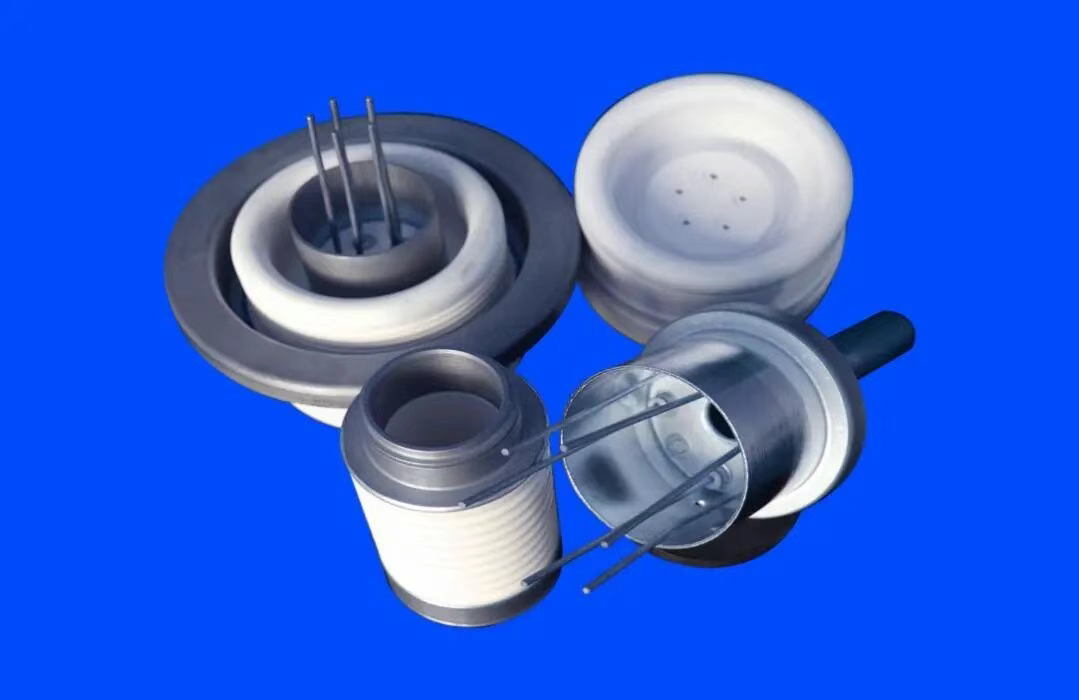
Molybdenum-manganese metallization is now a highly mature and reliable ceramic metallization technology. It provides ceramics with a surface that is easily wetted by molten metal, making it an indispensable key step in ceramic-metal brazing. This has advanced the development of ceramic-metal sealing products with high strength, insulation, and ultra-high vacuum compatibility.
We will also introduce other ceramic metallization methods in subsequent articles. If you are interested in these products, please click here to contact us!