Technical Article
Coaxial Vacuum Feedthroughs: RF Design, 50 Ohm Matching, and Selection
A coaxial vacuum feedthrough carries an RF, microwave, or low-level electrical signal through a vacuum-chamber wall while preserving both the pressure boundary and the coaxial transmission path. Unlike a simple insulated pin, it maintains a center conductor, dielectric, and outer shield across the wall so that impedance, shielding, and hermeticity remain controlled. Selection therefore has to satisfy two systems at once: the vacuum seal and the RF circuit.
What Is a Coaxial Vacuum Feedthrough?
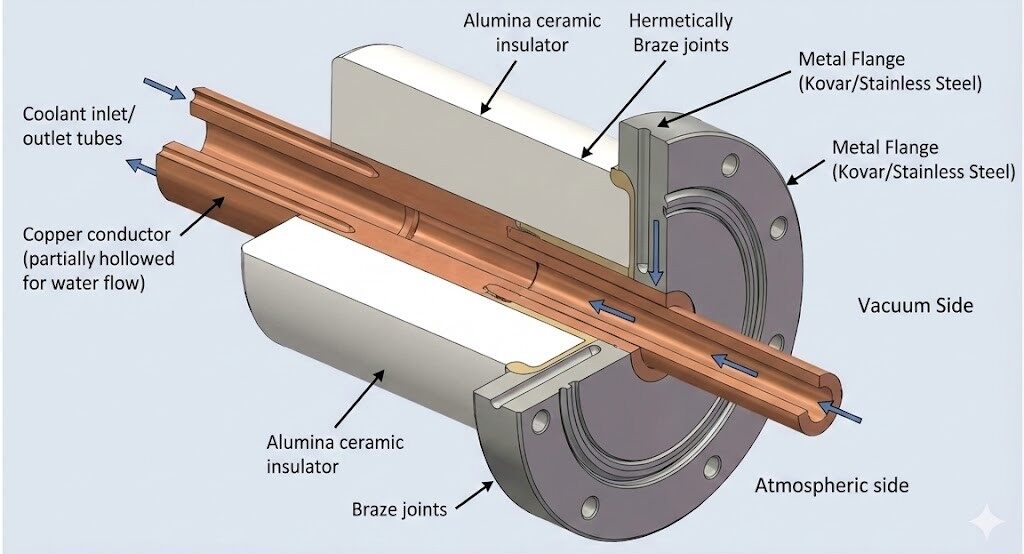
A coaxial vacuum feedthrough is a hermetically sealed, concentric electrical transition installed through a chamber wall or flange. Its inner conductor carries the signal; its outer conductor provides the return path and electromagnetic shield; and a ceramic or glass-ceramic dielectric separates them while forming part of the vacuum barrier.
This geometry distinguishes a coaxial feedthrough from a power feedthrough or ordinary instrumentation pin. A power pin may be satisfactory for direct current or low-frequency power, but an RF signal behaves as a travelling electromagnetic wave. Any abrupt change in conductor diameter, dielectric constant, grounding, or connector geometry creates a discontinuity that can reflect energy back toward the source.
Why 50 Ohm Matching Matters in an RF Vacuum Feedthrough
For a circular coaxial line, characteristic impedance is controlled mainly by the ratio of the outer-conductor inner diameter to the center-conductor outer diameter and by the dielectric's relative permittivity. A useful approximation for a nonmagnetic dielectric is:
Z0 ≈ (138 / √εr) log10(D/d)
Here, Z0 is characteristic impedance, εr is relative permittivity, D is the inner diameter of the shield, and d is the outer diameter of the center pin. When the wave moves from a polymer-insulated cable into a high-permittivity ceramic, the geometry must change if the transition is to remain near 50 ohms.
An impedance error does not merely change a resistance reading. It produces a reflected wave. In practice, engineers evaluate the transition with a vector network analyzer and report return loss or VSWR together with insertion loss. A low-loss feedthrough at one frequency may perform poorly over a broad band if a ceramic step, pin shoulder, connector launch, or grounding path creates resonance.
The 50 ohm label is therefore a controlled RF specification, not a direct-current resistance value. The complete requirement should state the usable frequency band, maximum VSWR or minimum return loss, and maximum insertion loss at defined reference planes. A 50 ohm vacuum feedthrough should consequently be purchased against a frequency-dependent performance envelope, not against the impedance label alone.
How Hermetic Coaxial Feedthroughs Are Built
The core assembly typically combines a center conductor, ceramic insulator, metal sleeve or flange, metallized interfaces, and brazed joints. The ceramic supplies electrical isolation and vacuum compatibility; the metal members provide mechanical support, welding surfaces, and RF current paths.
Ceramic selection
High-purity alumina is common because it combines dielectric strength, low outgassing, chemical stability, and compatibility with established ceramic-to-metal sealing processes. Its relatively high permittivity, however, makes impedance compensation important. Lower-purity alumina can be easier to metallize, while higher-purity grades generally reduce dielectric loss and improve resistance to aggressive process environments.
Aluminum nitride can be useful when heat removal is more important because it has much higher thermal conductivity than conventional alumina. Machinable glass-ceramics can shorten prototype cycles but normally sacrifice thermal conductivity, strength, or high-frequency loss performance. Material selection must be based on actual frequency, temperature, power, chemical, and manufacturing requirements rather than a single property.
Metal selection and thermal expansion
Ceramic and metal expand by different amounts during brazing, bake-out, and service. A transition alloy with a compatible coefficient of thermal expansion reduces tensile stress in the ceramic as the joint cools. The conductor surface may also require a high-conductivity, nonmagnetic plating because RF current concentrates near the surface as frequency rises.
Metallization and brazing
Conventional molybdenum-manganese metallization followed by nickel plating is widely associated with metallizable alumina grades. Active-metal brazing uses a reactive element in the filler system to wet high-purity alumina or nitride directly. In either route, joint design, braze clearance, atmosphere, peak temperature, dwell time, and cooldown determine whether the seal remains both leak-tight and mechanically stable. A deeper treatment is available in the Ceramic-Solutions guide to ceramic-to-metal brazing.
Connector and Frequency Selection
Connector names alone do not guarantee system bandwidth. Feedthrough construction, flange launch, ceramic geometry, mating cable, and test reference plane all affect performance. The ranges below are planning guides; the qualified datasheet for the exact assembly controls.
| Interface | Typical design role | Practical selection focus |
|---|---|---|
| BNC | General laboratory and instrumentation signals; 50 or 75 ohm variants | Confirm impedance, upper frequency, voltage, and full vacuum-side shielding |
| MHV / SHV | Higher-voltage coaxial service | Prioritize voltage, creepage, connector safety, and whether controlled 50 ohm performance is specified |
| Type N | Mechanically robust RF connection | Check bandwidth, power, flange size, and nonmagnetic requirements |
| SMA | Compact RF and microwave transition | Check torque, mating cycles, bandwidth, plating, and bake-out limit |
| 2.92 / 2.4 / 1.85 mm | Microwave and millimetre-wave work | Require assembly-level S-parameter data and tight mechanical tolerances |
| SMP / SMPM | Dense or blind-mate arrays | Check detent style, misalignment, cable loss, and thermal anchoring |
For broadband measurement, do not select solely from the connector's theoretical upper frequency. Ask for measured S-parameters for the full feedthrough assembly over the intended band. For high RF power, also evaluate peak electric field, conductor heating, multipaction risk, and heat rejection in vacuum, where convection is absent.
Grounded or Floating Shield?
A grounded-shield feedthrough bonds the outer conductor to the flange and chamber. It provides a short RF return path and is usually the natural choice for high-frequency transmission when the chamber is part of the ground structure.
A floating-shield feedthrough isolates the coaxial outer conductor from the flange. This can break unwanted ground paths in low-level instrumentation, guarded measurements, or systems where chamber noise would otherwise enter the signal reference. The additional dielectric boundary makes the mechanical and electrical design more complex, so isolation voltage, capacitance to the flange, and frequency response should be specified.
Single-ended versions leave a pin or solder termination on the vacuum side. Double-ended versions preserve a standard coaxial connection on both sides and normally provide better-defined shielding and easier cable replacement. The choice depends on space, serviceability, outgassing, and whether a continuous controlled-impedance path is required inside the chamber. For low-level non-coaxial channels, compare the design with an instrumentation feedthrough.
CF, KF, Weldable, or Threaded Mounting
The mounting interface and the internal feedthrough seal are separate boundaries. A ceramic-to-metal braze can be hermetic while an unsuitable flange gasket still limits the system, and a perfect flange cannot compensate for a leaking braze joint.
- CF flanges use a deformable metal gasket and are preferred for UHV, high-temperature bake-out, and long-term metal-sealed service.
- KF or NW flanges use an elastomer O-ring and clamp. They are fast to assemble and useful in many high-vacuum systems, but gasket permeation and temperature limits must be accepted.
- Weldable feedthroughs minimize interfaces and support compact custom chambers, but replacement requires cutting or rework.
- Threaded or face-seal mounts can be practical for pressure vessels and serviceable bulkheads when their sealing method is compatible with the required vacuum and temperature.
A Nine-Step Coaxial Feedthrough Selection Method
- Define the signal type and frequency band, including harmonics and pulse rise time.
- State the required impedance and RF limits: VSWR or return loss, insertion loss, and power.
- Define maximum operating voltage, current, and fault or transient conditions.
- Set the vacuum class and maximum acceptable helium leak rate.
- Specify operating, bake-out, cryogenic, and thermal-cycling temperatures.
- Identify magnetic, radiation, plasma, corrosion, and contamination constraints.
- Select connector family, grounded or floating shield, and single- or double-ended termination.
- Select CF, KF, weldable, or threaded mounting and confirm available port size.
- Agree on acceptance tests and the exact electrical reference planes before release.
This sequence prevents a common procurement error: choosing a familiar connector first and attempting to force the remaining requirements around it. If the channel is intended to deliver current rather than preserve a controlled signal path, use the separate power feedthrough selection criteria.
Qualification and Acceptance Testing
A useful qualification plan tests the vacuum, electrical, RF, thermal, and mechanical functions as one assembly.
| Test | What it verifies | Important reporting detail |
|---|---|---|
| Helium mass-spectrometer leak test | Integrity of ceramic-to-metal joints, welds, and seals | Test direction, tracer method, sensitivity, and acceptance leak rate |
| VNA S-parameter sweep | Return loss, VSWR, insertion loss, and resonances | Frequency span, calibration plane, cables/adapters, and temperature |
| Insulation resistance and hipot | Dielectric isolation and voltage margin | Test voltage, dwell, ramp, leakage limit, and atmosphere/vacuum condition |
| Thermal cycle or bake-out | CTE compatibility, braze stability, and material cleanliness | Temperature extrema, ramp rate, dwell, cycle count, and post-test leak rate |
| Inspection and torque verification | Connector alignment, cracked ceramic, loose interfaces, and repeatability | Mating torque, cycles, magnification, and acceptance criteria |
NASA connector guidance highlights that ordinary connector seals, lubricants, markings, and polymer accessories may require additional outgassing control before vacuum service. Vacuum suitability must therefore be evaluated for the entire mated cable system, not only the ceramic feedthrough body.
Common Failure Modes and Corrective Actions
Unexpected VSWR or insertion loss
Likely causes include a 50/75 ohm mix-up, an uncompensated ceramic section, poor connector torque, a damaged center contact, a long unshielded vacuum-side pin, or calibration planes that exclude critical adapters. Verify the complete chain with time-domain gating or TDR where available, then isolate each transition.
Persistent vacuum leak after bake-out
Separate a true leak from permeation, outgassing, or a virtual leak. Inspect the flange gasket and bolt pattern before condemning the ceramic braze. Helium response timing and repeated background measurements help distinguish a direct leak path from trapped gas.
Ceramic flashover or insulation breakdown
Surface contamination, insufficient creepage distance, sharp electric-field features, and conductive deposits can cause failure below the nominal bulk dielectric strength. Keep ceramic surfaces clean, avoid bare-hand contact, and validate the assembly under the actual pressure and temperature regime.
Drift after thermal cycling
Cracked plating, braze fatigue, connector movement, or CTE mismatch can change RF performance without producing an obvious gross leak. Repeat both leak and S-parameter tests after thermal qualification because either test alone can miss a coupled failure.
Applications and Design Limits
Coaxial vacuum feedthroughs support semiconductor plasma tools, electron microscopes, particle accelerators, fusion diagnostics, vacuum coating systems, cryogenic detectors, and quantum measurement hardware. Each application stresses a different part of the design: plasma tools emphasize chemical resistance and contamination; accelerators emphasize RF power and radiation; cryogenic systems emphasize heat leak and nonmagnetic materials; and precision instruments emphasize noise isolation and repeatability.
A reliable coaxial vacuum feedthrough is not simply a connector attached to a flange. It is a coupled vacuum, RF, thermal, and materials system. Define the operating envelope first, require assembly-level test evidence, and then select geometry and materials that preserve the hermetic boundary and the 50 ohm signal path throughout service.
Frequently Asked Questions
Need custom coaxial vacuum feedthrough support?
Contact Our TeamEngineering References
- National Institute of Standards and Technology, Electrical Parameters of Precision Coaxial Air-Dielectric Transmission Lines.
- NASA Electronic Parts and Packaging Program, MIL-DTL-39012 Radio Frequency Connector Application Notes.
- ITER Organization, Positioned at the Vacuum Boundary: Diagnostic Feedthroughs.
- I. Kreslo et al., 30 kV Coaxial Vacuum-Tight Feedthrough for Operation at Cryogenic Temperatures.