Technical Article
Ceramic Bearings vs Steel Bearings: When Is the 2-3x Price Worth It?
If the application has normal load, normal speed, good lubrication and a clean industrial environment, steel bearings are usually the better economic choice. Ceramic bearings can cost 2-3x more than comparable steel bearings, and that premium is only easy to justify when high temperature, high speed, corrosion, electrical insulation, poor lubrication or high downtime cost changes the total cost of ownership.
This guide is written for engineers, procurement teams and technical buyers comparing ceramic bearings vs steel bearings for real equipment, not just performance upgrades. The short answer is simple: start with steel unless the operating conditions expose a clear steel-bearing failure mode.
Quick Verdict: Choose Steel, Hybrid Ceramic or Full Ceramic?
| Use Case | Best Starting Option | Why |
|---|---|---|
| Ordinary industrial machinery with good lubrication | Steel bearing | Lowest purchase cost, broad availability and proven maintenance practices. |
| High-speed spindle or electric motor | Hybrid ceramic bearing | Silicon nitride balls reduce rolling element mass and can help with electrical insulation. |
| Corrosive washdown or chemical exposure | Full ceramic bearing or ceramic component | Steel rings remain vulnerable in hybrid bearings. |
| High temperature beyond standard lubricant or steel-ring comfort | Ceramic or special high-temperature bearing design | Material, cage and lubrication must be selected together. |
| Vacuum, cleanroom or lubrication-restricted use | Ceramic bearing or ceramic sliding component | Lower contamination risk and better performance under limited lubrication. |
| High shock load, severe misalignment or rough installation | Steel bearing | Steel usually has better toughness and installation tolerance. |
What Are Ceramic Bearings?
Ceramic bearings use advanced ceramic materials such as silicon nitride (Si3N4), zirconia (ZrO2), alumina (Al2O3) or silicon carbide (SiC). The most common high-performance rolling elements are silicon nitride balls because they combine low density, hardness, thermal stability and good fracture toughness compared with many other ceramics.
There are three common product types:
- Steel bearings: steel rings and steel rolling elements.
- Hybrid ceramic bearings: ceramic balls, usually silicon nitride, with steel rings.
- Full ceramic bearings: ceramic rings and ceramic rolling elements, often with a polymer or ceramic cage depending on the environment.
This distinction matters. A hybrid ceramic bearing is not a full corrosion-proof ceramic bearing. If the steel rings are exposed to aggressive chemicals, washdown or saltwater, the ceramic balls alone will not solve the corrosion problem.
Why Ceramic Bearings Cost More Than Steel Bearings
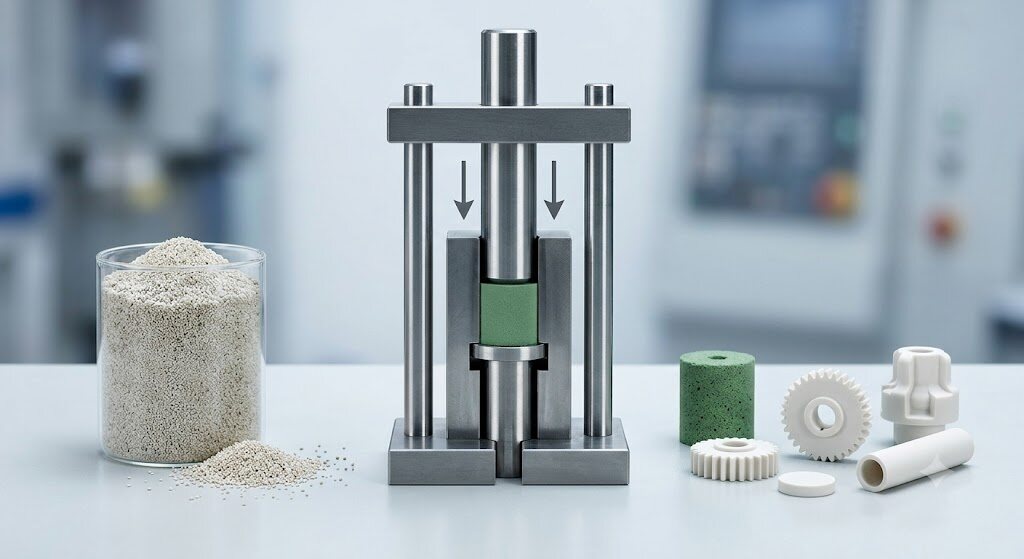
The price difference comes from materials, processing and inspection. Steel bearings benefit from a mature global supply chain, high production volume and many interchangeable standard sizes. Ceramic bearing components require ceramic powder preparation, forming, sintering, precision grinding and stricter inspection for surface defects, cracks and batch consistency.
CeramTec silicon nitride material data lists Si3N4 at a density of 3.21 g/cm3, flexural strength of 850 MPa, fracture toughness of 7 MPa m1/2, maximum operating temperature of 1,300°C in oxidizing atmosphere and 1,600°C in neutral atmosphere. Those properties help explain why the material can be valuable in demanding bearing applications, but they also explain why it is not priced like commodity bearing steel.
Ceramic Bearings vs Steel Bearings: Performance Comparison
| Factor | Steel Bearings | Ceramic Bearings |
|---|---|---|
| Purchase cost | Usually lowest. | Commonly 2-3x higher, sometimes more. |
| Availability | Very broad, short lead times. | More limited by material, size and grade. |
| Speed | Excellent for normal and many high-speed applications. | Strong advantage when rolling element mass becomes a limit. |
| Temperature | Limited by steel grade, cage and lubricant. | Ceramic materials can handle higher temperatures, but the full assembly must match. |
| Corrosion | Chrome steel corrodes; stainless helps but has limits. | Full ceramic offers stronger corrosion resistance in many media. |
| Electrical insulation | Conductive. | Ceramic rolling elements or full ceramic designs can reduce current paths. |
| Lubrication | Needs the right lubricant and maintenance. | Can perform better under limited lubrication, but not friction-free. |
| Load and shock tolerance | Usually better for impact and abuse. | Needs careful design against impact, misalignment and edge loading. |
| Maintenance economics | Low replacement cost. | Best when longer life or avoided downtime offsets the higher price. |
When Steel Bearings Are the Better Choice
Steel bearings are the right default when the application is not pushing material limits. They are economical, familiar to maintenance teams, easy to source and available in many precision classes, seal types and cage designs.
Choose steel first when:
- The operating temperature is within standard bearing and lubricant limits.
- Lubrication is stable and contamination is controlled.
- The environment is not strongly corrosive.
- Speed is not high enough for rolling element mass to become a major heat or stress issue.
- Bearing replacement is fast, low-cost and does not stop a critical process.
- The application includes shock loads, rough handling or alignment uncertainty.
This is the point many comparison pages underplay: ceramic is not automatically the better engineering answer. If a steel bearing already meets the load, life and environment requirements, paying more for ceramic may only increase part cost.
When Ceramic Bearings Are Worth the Premium
Ceramic bearings become easier to justify when steel-bearing failure costs more than the ceramic upgrade.
1. High Speed
At high speed, rolling element mass affects centrifugal force, heat generation and contact stress. Silicon nitride balls are much lighter than steel balls, so hybrid ceramic bearings can be useful in high-speed spindles, precision motors and other high DN-value applications.
2. High Temperature
Ceramics can tolerate higher temperatures than common bearing steels, but the full bearing design still matters. Rings, cages, seals, fits, clearance and lubrication must be selected as a system. Replacing only one component with ceramic does not automatically create a high-temperature bearing.
3. Corrosion and Washdown
Food equipment, chemical processing, marine exposure, semiconductor wet processes and repeated washdown can shorten steel-bearing life. Full ceramic bearings or custom ceramic components may reduce corrosion-related replacement, especially when stainless steel is still not enough.
4. Poor Lubrication, Vacuum or Clean Environments
Some applications cannot tolerate oil migration, grease contamination or lubricant outgassing. Ceramic materials can be valuable in cleanrooms, vacuum systems and lubrication-restricted equipment. The design still needs a load-speed-temperature check because ceramics do not remove the need for tribological planning.
5. Electrical Insulation
Variable-frequency-drive motors, generators and electric drive systems can suffer bearing current damage. Hybrid ceramic or full ceramic bearings can help interrupt current paths through the rolling contact. They should be evaluated alongside grounding, insulated housings, shaft grounding rings and lubricant selection.
A Simple ROI Formula for Ceramic Bearing Cost
Use this first-pass test before approving a ceramic upgrade:
Extra ceramic bearing cost < avoided downtime + reduced maintenance + avoided corrosion damage + avoided contamination + reduced lubrication-system cost
Example: if a steel bearing costs $100 and a ceramic alternative costs $250, the extra purchase cost is $150. If one unplanned failure stops a line that costs $5,000 per hour, the ceramic option does not need to last forever to make economic sense. It only needs to reduce the probability or frequency of an expensive failure enough to cover the premium.
The reverse is also true. If the bearing is easy to replace, stocked locally and not tied to expensive downtime, steel may remain the lowest-cost answer even if ceramic has better material properties.
Full Ceramic vs Hybrid Ceramic Bearings
Hybrid ceramic bearings and full ceramic bearings solve different problems.
| Bearing Type | Structure | Best Fit | Main Limitation |
|---|---|---|---|
| Hybrid ceramic | Ceramic balls with steel rings. | High speed, electric motors, lower rolling element mass, partial insulation. | Steel rings still limit corrosion and high-temperature capability. |
| Full ceramic | Ceramic rings and ceramic rolling elements. | Corrosive media, non-magnetic use, high temperature, clean or vacuum environments. | Higher cost, lower tolerance for impact and installation errors. |
| Steel | Steel rings and steel rolling elements. | Standard machinery, heavy load, broad replacement availability. | Corrosion, current damage, lubrication failure and temperature can become limits. |
Do Not Buy Ceramic Bearings If These Conditions Apply
Ceramic bearings may not be worth it if:
- The failure history does not show corrosion, temperature, speed, lubrication or electrical-current problems.
- The equipment has severe shock loading or alignment problems that have not been fixed.
- The only goal is a vague reduction in friction without measured power, heat or life data.
- A low-cost steel bearing can be replaced during planned maintenance.
- The supplier cannot confirm material grade, precision class, cage material and fit recommendations.
In these cases, money is often better spent on better sealing, better lubrication, cleaner installation, higher-quality steel bearings or improved alignment.
Supplier Selection Checklist
Before asking SKF, NTN, Ceramic-Solutions or another supplier to recommend a bearing or ceramic component, prepare this data:
- Radial load, axial load, peak load and shock load.
- Continuous speed, maximum speed and start-stop cycle.
- Working temperature, ambient temperature and thermal cycling.
- Lubrication method: grease, oil, oil mist, dry running, vacuum or no lubrication.
- Media exposure: water, salt spray, acid, alkali, solvent, cleaning agent, dust or process gas.
- Electrical requirements: shaft current, insulation, non-magnetic needs or grounding design.
- Precision requirements: runout, noise, vibration, clearance and preload.
- Target life, downtime cost, replacement access and spare-part strategy.
- Installation constraints: shaft/housing material, fit, misalignment and thermal expansion.
Ceramic-Solutions can support custom advanced ceramic parts where a standard bearing is not enough, including ceramic rolling elements, insulating ceramic parts, corrosion-resistant components and precision-machined ceramic features. See Ceramic-Solutions manufacturing capabilities for related processing options. For clean, corrosive and precision process environments, the semiconductor ceramic components page may also be relevant.
Conclusion: Are Ceramic Bearings Worth It?
Ceramic bearings are worth the premium when the operating environment makes steel bearings expensive to own, not just cheap to buy. For ordinary equipment, steel bearings are usually the best value. For high speed, high temperature, corrosion, poor lubrication, electrical insulation or high downtime cost, hybrid ceramic or full ceramic bearings can make financial and engineering sense.
The best decision in ceramic bearings vs steel bearings is not ceramic vs steel in the abstract. It is matching bearing material, bearing structure and total cost of ownership to the failure mode your equipment actually has.
FAQ
Need custom ceramic material selection or precision ceramic component support?
Contact Our TeamEngineering References
- SKF rolling bearing selection principles for bearing selection based on load, speed, life and operating conditions.
- SKF hybrid deep groove ball bearings for hybrid bearing terminology and product category reference.
- CeramTec silicon nitride material data for Si3N4 density, strength, toughness and temperature values.